


Let’s be brutally honest: if you’re spending more than 60 seconds crafting a prompt, you’re already losing.
The digital landscape is flooded with people who treat AI like a magic 8-ball, tossing in vague queries and hoping for a usable answer. They get generic, beige, and unusable fluff 90% of the time. This isn’t a failure of the model; it’s a failure of input.
This is the only guide you need on AI prompting. We’re cutting through the noise and focusing on the 20% of prompts that deliver 80% of the results. This is about precision, leverage, and maximizing high-quality output for minimum time investment.
If you’re serious about moving past the novice stage and using AI to secure an unfair advantage, you need to master the three non-negotiable prompt archetypes.
The Great Prompt Lie: Why Most Users Fail
The vast majority of users rely on descriptive prompting: “Write a blog post about how to use social media.”
What’s the result? A five-paragraph, high-school-level essay that needs a full rewrite to be viable. That’s because the AI is a prediction engine—it predicts the most statistically average, safe, and generic response possible.
To get an alpha-level response, you must override that safety setting. You don’t ask the AI what to write; you command how to write it. The difference between winning and wasting time comes down to these three architectural concepts.
Archetype 1: The Constraint Prompt (Focus Is Power)
Amateurs ask for “more.” Experts demand “less.”
The Constraint Prompt is the single most powerful tool for forcing the AI to be concise, sharp, and focused. It limits the response surface, compelling the model to condense its knowledge into a specific, actionable format.
Your Non-Negotiable Constraints:
- Format: Always specify the output structure. (e.g., “Create a two-column markdown table,” or “Deliver a bulleted list of exactly five points.”)
- Length: This is vital for social media and headlines. (e.g., “Must be under 280 characters,” or “Write 3 headlines, each under 60 characters.”)
- Tone & Audience: Define the voice instantly. (e.g., “Write this in an aggressive, authoritative voice for a B2B audience of CTOs.”)
Example of an Alpha-Level Constraint Prompt:
“Write three distinct, punchy LinkedIn post ideas about the hidden costs of cloud migration. Each idea must consist of one headline (under 10 words) and two accompanying bullet points. The tone must be urgent and executive-level. Deliver the output as a simple numbered list.”
Result: Immediate, high-utility social content ready for publication.
Archetype 2: The Persona Prompt (Expertise on Demand)
Why accept a general answer when you can command an expert?
The Persona Prompt is the secret weapon for injecting authority and niche expertise into every output. By assigning the AI a specific, high-value professional identity, you force it to access and synthesize information through a focused lens.
How to Command a Persona:
- Job Title: Start with “Act as…” or “You are a…” (e.g., “You are a former Goldman Sachs investment banker,” or “Act as a 10x developer specializing in Python automation.”)
- Goal: Define the objective of that persona. (e.g., “Your goal is to tear down the flaws in this pitch deck,” or “Your goal is to optimize this landing page for a 15% conversion lift.”)
- The Power Move: Don’t just assign the persona—demand the reasoning behind the output. This forces the AI to reveal its strategy, turning a simple answer into a learning experience.
Example of an Alpha-Level Persona Prompt:
“Act as a highly skeptical private equity investor known for ruthless efficiency. Review the following financial summary for a hypothetical SaaS startup: [Paste Summary Here]. Your sole objective is to identify the three biggest operational red flags that would cause you to immediately walk away from the deal. After listing the red flags, justify each one with a single sentence of reasoning.”
Result: Instant, strategic risk analysis that rivals a costly consultant.
Archetype 3: The Framework Prompt (Logic Over Fluff)
Generic responses follow generic structure. Strategic responses follow a tested, proven framework.
A Framework Prompt eliminates creative guesswork by forcing the AI to structure its output according to established logical models used by the world’s best marketers and strategists. This guarantees the output has a usable, conversion-focused backbone.
Essential Frameworks to Master:
- AIDA (Attention, Interest, Desire, Action): Perfect for ad copy, social media teasers, and short pitch summaries.
- PAS (Problem, Agitate, Solve): Ideal for email marketing, blog introductions, and pain-point-focused lead generation.
- SCAMPER (Substitute, Combine, Adapt, Modify, Put to another use, Eliminate, Reverse): Use this for product ideation, brainstorming, and innovation strategy.
Example of an Alpha-Level Framework Prompt:
**”Apply the AIDA framework to this new service: a 24-hour emergency data recovery service for small businesses.
A: Write a terrifying headline (Attention).
I: Detail the consequences of downtime (Interest).
D: Explain the feeling of immediate relief (Desire).
A: Provide a clear call to action (Action).
Keep the total output under 200 words.”**
Result: Structured, persuasive copy built for conversion, ready to plug into a landing page or email sequence.
The Ultimate AI Prompt Library: Your Secret Weapon
The real minimum effort comes from maximum leverage. Once you spend the time—the single, focused minute—to craft a powerful prompt using the archetypes above, you should never have to write it again.
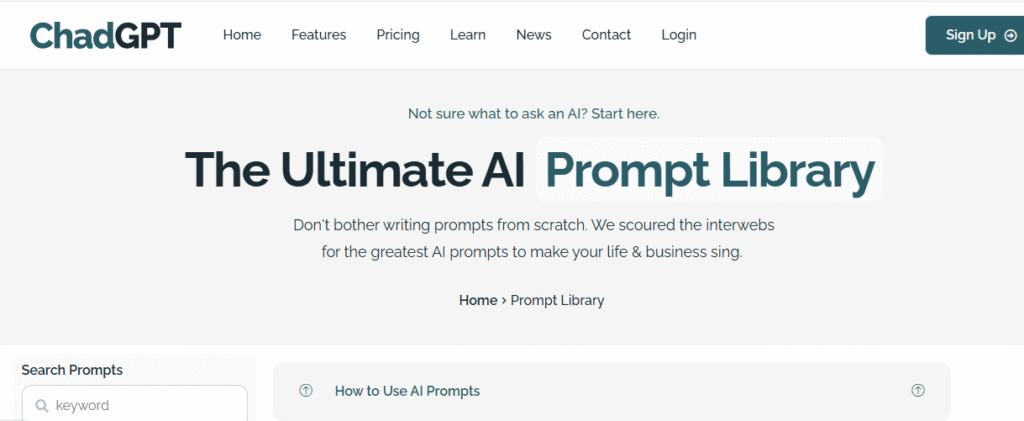
The Ultimate AI Prompt Library is not some paid download; it’s a simple document containing your own collection of these high-leverage prompts.
How to Build Your Library:
- The Master Template: Create a core prompt for every recurring task (e.g., “Write a LinkedIn post,” “Analyze this document,” “Draft an email reply”).
- The Variable: Use bracketed placeholders for easy insertion (e.g., [TOPIC], [TONE], [TARGET AUDIENCE]).
- The Re-Use Principle: Whenever you need to perform a task, copy the relevant Master Template from your library, drop in the variables, and execute. This turns a one-minute creation task into a 10-second execution task.
This workflow guarantees speed, consistency, and expert-level output every single time. Stop treating AI like a toy. It’s an engine of leverage, but only if you command it with precision.
You have the tools. Now execute.